
After the ECB interview: insurer protection in SRT
On 21 October, EU negotiators reached a provisional political agreement on securitisation reform. The Council said it would "enable the participation of insurers and reinsurers in the synthetic securitisation market", and we wrote at the time about what STS eligibility could mean for insurer-backed significant risk transfer (SRT).
Nine days later, the ECB set out the supervisory view. In an interview published on 30 October, Pedro Machado, a Member of the Supervisory Board of the ECB, called securitisation that enables properly structured SRT "a legitimate and efficient instrument". On insurers he was more cautious, saying the agreement's treatment of their unfunded protection "deviates from our recommendation".
Read alongside AFME's response to the agreement, and earlier positions from EIOPA and the IACPM, the interview gives a useful picture of where the debate may be heading. The provisional agreement points towards a role for insurers. How their protection is structured, tested and supervised looks like the part still to be settled.
What the agreement appears to change
Under the current rules, unfunded credit protection on STS synthetic securitisations can only come from public bodies such as sovereigns, central banks and multilateral development banks. Insurers are already active in SRT outside the STS label. The IACPM's latest insurer survey, as reported by Finadium, found that insurers protected €4.7bn of SRT tranches in 2025, up from €2.7bn in 2024.
The provisional agreement would open the STS route to them. Paul Hastings' summary says certain synthetic securitisations with unfunded protection from qualifying insurers and reinsurers would be able to qualify as STS, "subject to requirements relating to the protection provider's regulatory status, financial strength and creditworthiness".
AFME's reading adds the capital side. It says insurers' unfunded protection "appears to become eligible for 'resilient' treatment", and reports "a 5% ultimate floor for resilient STS securitisations" against "a 7% ultimate floor for non-resilient STS securitisations". For a bank deciding whether a trade is worth doing, that difference could matter. AFME still described the reported calibrations as "overly conservative".
Two caveats apply to all of this. The final text has not been published, and the agreement still has to be finalised and formally endorsed by both co-legislators. The figures above are as reported, not as enacted.
Where the concerns sit
Machado's main concern is specific: an insurer that "is not able to continue honouring its protection". That protection is what a bank's capital relief rests on. He also questioned the calibration. The ECB prefers absolute floors, he said, adding: "I think, in particular on the resilient STS, that we might be going too low."
On structures where insurers take on the credit risk of notes that banks finance, he added: "The more complex the structure becomes, the more uncomfortable we are with these sorts of transactions." He described the market as "fairly opaque", while noting that the ECB had not yet seen a particular case of these risks materialising and was monitoring the situation. He was also clear that the final text was not yet known.
The EU insurance supervisor has raised related points. In a September piece published by EIOPA, it described unfunded protection as "a contingent liability that may crystallise when credit conditions deteriorate", and said: "In EIOPA's view, the safeguards currently under discussion do not adequately address these concerns." The same piece acknowledged that "Broadening eligible providers could increase risk-sharing and reduce costs."
AFME came at it from the other side. It welcomed the direction, but warned that the Commission's reportedly proposed safeguards "add complexity to the framework and appear difficult to operationalise in practice". Earlier, in May, the IACPM had argued that the STS safeguards as then drafted "exclude de facto credit insurance except two groups among the currently active SRT insurers".
As we read it, the disagreement is narrower than it might look. Supervisors want confidence that the protection will hold. Market bodies want conditions that can be met in practice. Both aims seem reasonable, and they need not pull against each other.
A question of structure
Regulated insurers exist to take on risk. They are capitalised and supervised to do so, under Solvency II in the EU and Solvency UK in the UK. For us, the question that follows is whether the protection is structured to hold up for the life of the trade. Three things look central.
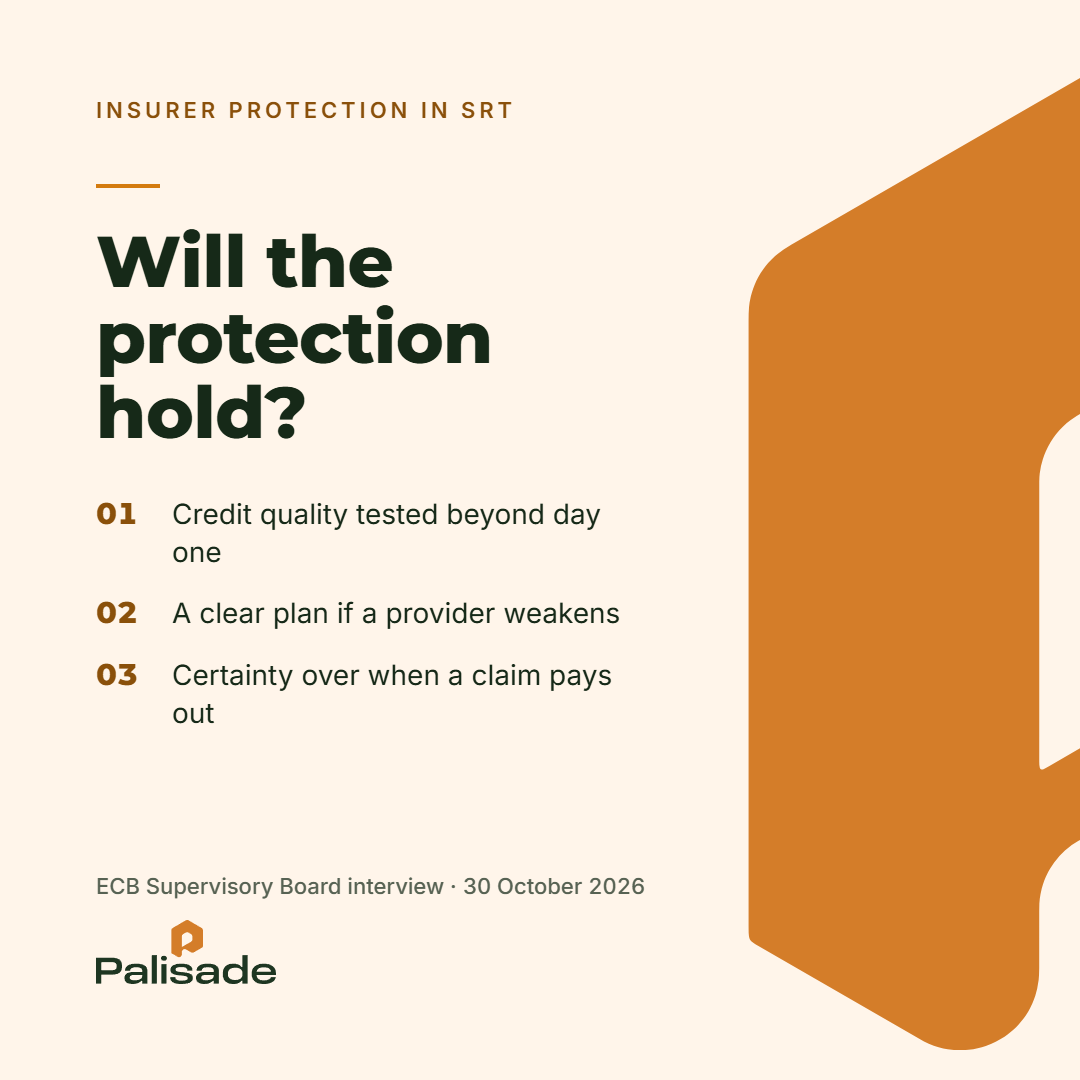
Credit quality tested beyond inception. An SRT trade can run for many years. A provider that is strong at signing needs to stay strong, so tests that apply during the life of the trade, not only at the start, speak directly to Machado's concern.
A clear plan if a provider weakens. If a provider's position deteriorates, the documents should set out in advance what happens next, whether that is posting collateral, replacing the provider or another agreed route. The bank should not be left to negotiate under stress.
Certainty over when a claim pays out. Unfunded protection only does its job if a valid claim pays when the capital treatment assumes it will. Clear definitions of what triggers a claim, how loss is measured and when payment is due go a long way.
None of this is new to SRT. What may be new is how far it is written into the rules.
That work, underwriting to the insurer's standards while structuring for the bank's capital needs, is the role we have built Palisade to play. Palisade is designed to operate as a managing general agent under delegated authority from an insurer. That puts the model between the two sides of this debate: the insurer's risk appetite on one side and, on the other, the bank's need for protection it can rely on.
Where it could matter most
If the final text follows the reported terms, the effect could be felt most in the asset classes insurers already cover. In the IACPM survey, large corporate, SME and business lending made up 58% of insurers' new SRT business in 2025, and residential mortgages 20% of newly protected portfolios. As reported, the survey also found that insurers hold a larger share of longer-term assets than the broader SRT market.
That fits a wider point. Insurers' longer-dated liabilities can make them a natural match for long-dated assets such as mortgages. In its May letter, the IACPM said that "A lower risk weight floor on senior tranches and the eligibility of insurers as protection providers are necessary" to unlock SRT on long-term assets such as mortgages.
Capital rules are only part of the picture. EIOPA has said it does not expect "the Solvency II revisions, on their own, to be a significant driver" of insurer participation in securitisation. For banks, the potential prize is capital released for new lending to the corporates, SMEs and households that SRT portfolios typically cover. Machado's description of properly structured SRT as "a legitimate and efficient instrument" suggests the supervisor sees that value too.
What to watch in the final text
The final text, not yet published, should answer several open questions:
- How the provider requirements are framed. Whether "regulatory status, financial strength and creditworthiness" are set as clear, objective criteria, or left open to case-by-case judgement.
- What happens during the life of a trade. Whether the rules address a provider weakening after inception, and how.
- Whether the reported floors hold. AFME reported 5% for resilient STS and 7% for non-resilient STS. On resilient STS, Machado said "we might be going too low".
- How supervisors apply it. Even once the text is final, how the ECB and national supervisors assess these trades will shape how usable the route is.
The most important of these may be the first. If the conditions become standard checks, banks and insurers could meet them trade after trade, and supervisors would see the same tests applied each time. If they become bespoke tests, each transaction could turn into its own negotiation, adding the kind of complexity both the ECB and AFME have flagged, from different directions.
We think standard checks would serve both sides of this debate best. Supervisors would get the assurance they are asking for, and banks would get conditions they can plan around.
This article reflects the announcements available on 10 November 2026. It is for information only and is not legal, regulatory or investment advice.
Sources
- ECB Banking Supervision: interview with Pedro Machado, 30 October 2026
- AFME: EU securitisation agreement delivers progress, but prudential shortcomings remain
- Council of the EU: Council and Parliament strike deal to revitalise the EU's securitisation market
- Paul Hastings: EU securitisation reforms - provisional political agreement reached
- EIOPA: Reviving securitisation requires more than lower capital charges
- IACPM: letter on the EU securitisation package, 11 May 2026
- Finadium: Global SRT insurer survey shows €4.7bn protected tranches in 2025